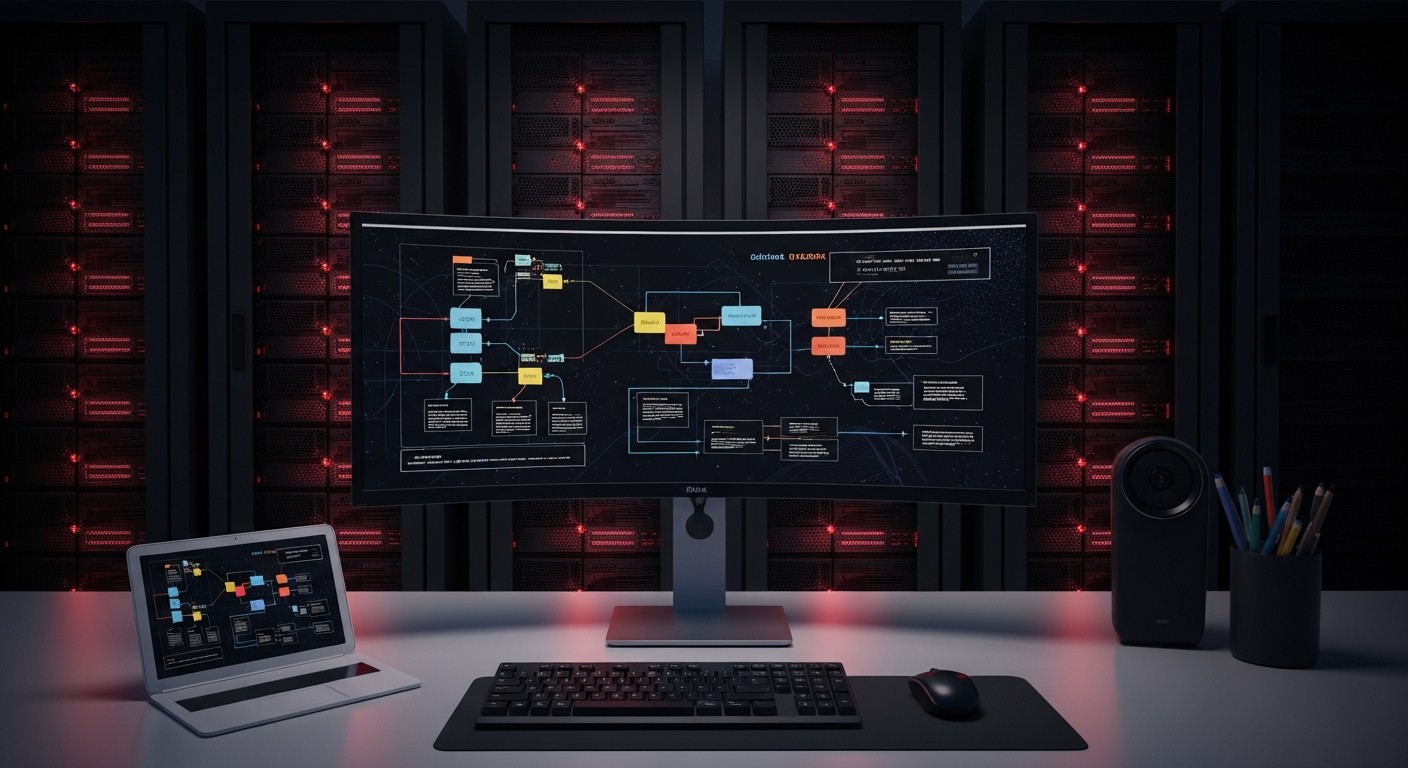
Modern organizational ecosystems rely heavily on rapid access to unstructured information across vast internal repositories. As context window capabilities expand, standard text querying often fails to extract precise nuances from complex technical manuals, customer support archives, and proprietary documentation. Incorporating retrieval-augmented generation (RAG) alongside specialized vector search engines provides a mechanism to query enterprise knowledge bases using natural language. Building these intelligent retrieval channels represents a fundamental evolutionary step within AI integrations for business, enabling applications to deliver contextualized answers while grounded directly in corporate data.
Understanding Retrieval-Augmented Generation and Vector Storage
Enterprise search implementations traditionally depended on keyword-matching algorithms like BM25, which calculate term frequency and inverse document frequency. While effective for verbatim query matches, exact keyword systems struggle with semantic intent, synonyms, and multi-faceted conceptual queries. Embedding models address this limitation by converting textual information into high-dimensional numerical vectors where conceptual similarity translates into mathematical proximity in vector space.
Retrieval-Augmented Generation pairs this vector-based semantic retrieval with large language models. Rather than relying on a model’s static training weights, the system dynamically retrieves relevant document chunks from a vector database and inserts them into the contextual prompt sent to the generative model. This approach minimizes model hallucination, provides verifiable attribution, and permits real-time updates to underlying information systems without retraining models.
The Role of High-Dimensional Vector Databases
Standard relational databases and traditional search engines are not optimized for calculating high-dimensional vector distance across millions of data points at sub-second speeds. Vector databases utilize specialized index structures to facilitate fast approximate nearest neighbor (ANN) searches. These vector platforms manage the storage, indexing, and transactional integrity of embedding vectors, offering API abstractions for querying contextual information across enterprise applications.
Core Structural Components in RAG Frameworks
Constructing a resilient retrieval pipeline involves distinct sequential phases designed to transform static corporate document repositories into dynamic context sources. Failure at any point in the pipeline degrades response accuracy and operational search efficiency.
- Document Parsing and Ingestion: Processing diverse digital file formats including digital documents, database records, source code files, and customer interaction logs into clean text strings.
- Chunking Strategies: Dividing long documents into manageable text blocks. Fixed-size chunking splits text strictly by character count, semantic chunking groups related ideas by paragraph headers, and parent-child chunking retains small context segments for retrieval while passing larger context windows to generative models.
- Embedding Generation: Passing document chunks through deep learning transformation pipelines using standardized models to output multi-dimensional vector arrays.
- Vector Indexing: Storing vector representations alongside original metadata fields within indexed database partitions to accelerate real-time similarity calculations.
- Retrieval and Generation: Interrogating the vector index during user queries to pull top matching segments, combining them with prompt templates, and forwarding the context window to language models for generation.
Engineering Challenges and Architectural Trade-Offs
Designing enterprise search infrastructure involves balancing computational performance against semantic accuracy. Selecting indexing algorithms represents a primary decision point in vector search architecture.
Indexing Strategies: HNSW versus IVF
Hierarchical Navigable Small World (HNSW) graphs and Inverted File Indexing (IVF) offer distinct operational profiles. HNSW constructs multi-layered graph structures that provide exceptional search speed and recall rates, though this comes at the cost of high memory consumption during vector lookup tasks. Conversely, IVF categorizes vector space into clusters, reducing RAM requirements by limiting search queries to specific vector centroids. However, IVF may trade off recall accuracy if queries fall along cluster boundaries. Deciding between graph-based and cluster-based indexing depends on system latency constraints and available server memory.
Hybrid Search and Re-Ranking Mechanisms
Pure vector search occasionally misses exact matches such as technical part numbers, acronyms, or specific customer IDs. Combining semantic vector retrieval with lexical BM25 keyword matching through hybrid search models yields balanced results across both semantic queries and exact term searches. Following initial hybrid retrieval, applying a cross-encoder re-ranking model recalibrates candidate documents by analyzing query-context interactions in detail, significantly boosting context accuracy before generation.
Integrating Search Pipelines into Application Frameworks
Integrating vector databases and retrieval mechanisms into mobile apps and web platforms requires careful attention to middleware architecture and state management. Modern API Integration practices allow front-end interfaces to interact seamlessly with background ingestion pipelines and retrieval engine nodes.
Security enforcement remains critical when implementing enterprise search. Role-Based Access Control (RBAC) ensures users only retrieve context from documents they are authorized to view. Integrating authorization filters directly into vector database queries prevents sensitive enterprise records from leaking into generated AI responses. Cloud Hosting solutions offer managed infrastructure, elastic scalability, and persistent storage setups to sustain fluctuating search loads across globally distributed enterprise applications.
Developing sophisticated digital solutions often involves coordinating Web Development and App Development effort to handle asynchronous stream responses, context caching, and semantic search interface rendering. Organizations evaluating advanced technological implementations must weigh software maintenance overhead, infrastructure costs, and latency expectations when deploying RAG infrastructure.
Leave a Reply